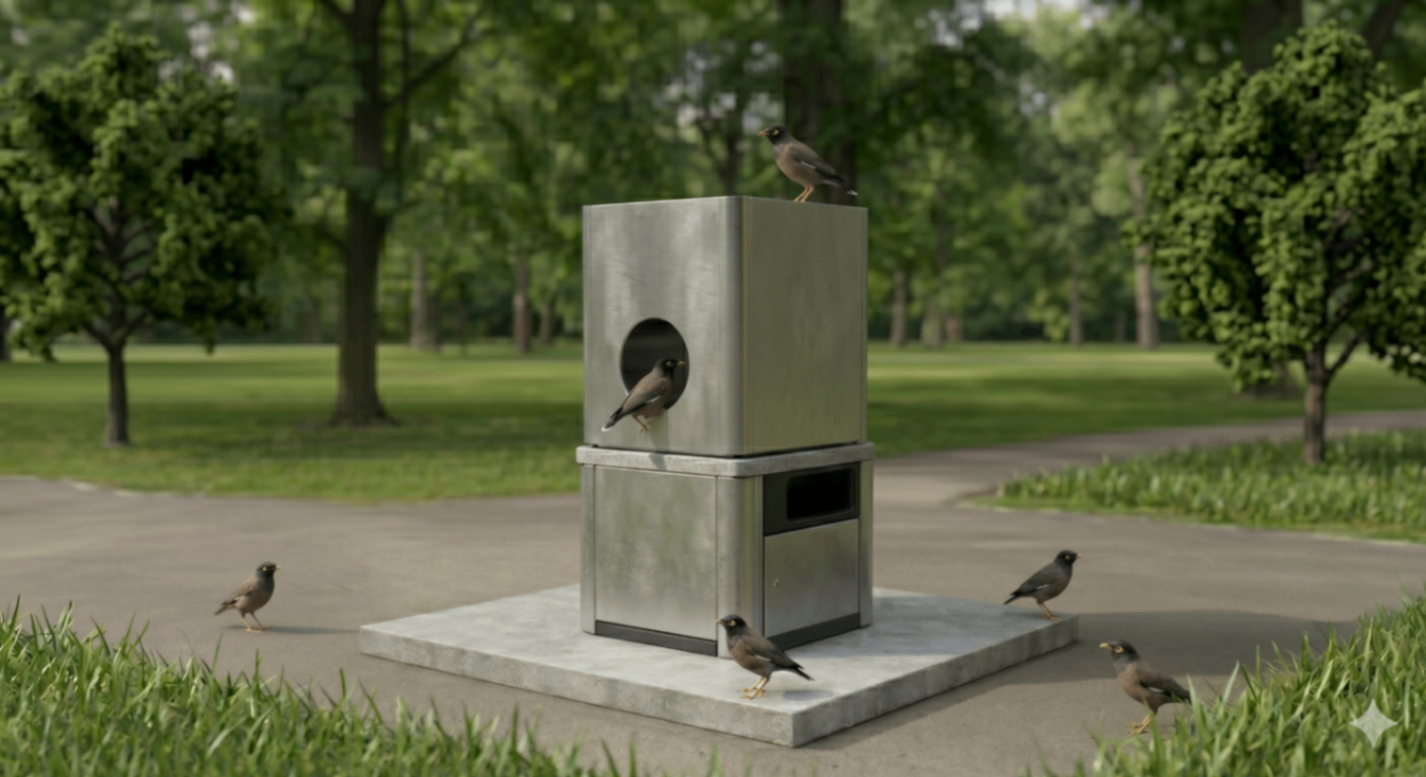
Single-Tunnel Bird Management Unit
The APC-N1 is a self-contained pest bird management unit that mounts directly on a bin — the bin is included. Battery-powered and wirelessly connected, it requires no mains power or fixed infrastructure. Available in four tunnel sizes to suit any target species, from house sparrows to Canada geese.
Battery Powered
DC rechargeable — no mains power or cabling required
Wi-Fi + GSM
Dual connectivity for reliable remote monitoring anywhere
AI Detection
Camera-based species ID before any action is taken
Field Testing
Designed June 2026 · Testing July–August 2026
Select Tunnel Size
Choose the tunnel that matches your target species. The tunnel height must exceed the bird's standing height.
Internal volume: 9.36 L
T1 Tunnel — Sparrow to Myna
Height
260 mm
Width
100 mm
Length
360 mm
Volume
9.36 L
Species height: ≤ 260 mm standing height
Target Species
Species compatible with the T1 tunnel — standing height ≤ 260 mm standing height.
| Specification | Value |
|---|---|
| Form factor | Bin-mounted (bin included) |
| Tunnels | 1 |
| Power | DC rechargeable battery |
| Connectivity | Wi-Fi / GSM card |
| Detection | Camera-based AI species ID |
| Identification accuracy | 99.7% |
| Euthanasia | CO₂ sequence |
| Disposal | Integrated bin (included) |
| Remote monitoring | APC Portal (full telemetry) |
| Remote commands | Supported |
| Ingress protection | IP54 rated |
| Operating temp | -10°C to +55°C |
Key Features
- Single-tunnel compact design
- Bin-mounted — no fixed installation required
- DC rechargeable battery — no mains power needed
- Wi-Fi and GSM connectivity
- Camera-based AI species identification
- CO₂ euthanasia sequence
- Remote monitoring via APC portal
- Full portal telemetry integration
- Remote command support
- Repositionable without infrastructure
Battery-Powered Deployment
Runs entirely on a DC rechargeable battery — rooftops, remote sites, and areas without mains power.
Bin Included
Ships with its own bin — mounts directly to the lid. A single self-contained assembly, no fixed infrastructure needed.
Need more capacity?
The APC-N8 offers 8 tunnels for high-pressure sites.
Everything a Bird Trap Should Be — and Nothing It Isn't
Traditional bird traps — cage traps, funnel traps, drop traps — have been used for decades. They work, but they require constant manual checking, carry a real risk of capturing non-target native species, and provide no data or audit trail. Every capture requires a human on site.
The APC-N1 is an automated bird trap that solves all of these problems. AI-powered species identification means only target pest birds are processed. Non-target species are never at risk. And because the unit is remotely monitored, you don't need to be on site until it's time to service it.
For homeowners, residents and local government lending programs, the APC-N1 is the most practical automated bird trap available — compact enough to deploy anywhere a bin can sit, with no mains power or fixed infrastructure required.
Traditional cage trap
- ✗Manual checking required
- ✗Non-target species risk
- ✗No species ID
- ✗No audit trail
- ✗Labour-intensive
APC-N1 automated bird trap
- ✓Remote monitoring — no site visits until service
- ✓0% non-target species risk via AI ID
- ✓Identifies 50+ pest bird species
- ✓Tamper-proof compliance logging
- ✓Operates unattended between service intervals
Getting the Best Results
A few simple steps during the first days of deployment can make a significant difference to how quickly birds accept the unit and how effective it becomes.
Allow an acclimatisation period
Once the unit is in position, give birds at least a few days to get used to it and begin feeding from it before activating euthanasia. Birds are cautious around new objects — patience at this stage significantly improves capture rates.
Keep your distance
Try not to linger near the device once it is deployed. Birds associate humans with danger. The less human activity around the unit, the faster birds will accept it as a safe feeding location.
Clean out at night
If the unit requires servicing or cleaning, do this after dark. Birds are not active at night and will not observe or associate the activity with the device, preserving their confidence in it as a food source.
Blend into the surroundings
Where possible, position the unit so it sits naturally within the environment. Camouflaging it against a fence, wall, or vegetation reduces novelty and helps birds accept it more quickly.
Add a nearby water source
Placing a small water fountain or bird bath close to the unit can increase the number of birds visiting the area, creating more feeding activity around the device and improving results.
Use larger bait initially for scavenger species
For scavenger-type birds such as the Indian Myna, start with larger bait pieces placed outside or near the entrance. This encourages them to associate the location with food before they begin entering the tunnel.
A Practical Entry Point for Local Government Programs
The APC-N1 is a practical, low-cost way for local governments to evaluate automated bird management technology before committing to larger infrastructure. Many local governments already lend traps to proactive residents on request. The APC-N1 fits naturally into this model — compact, self-contained, and straightforward to operate — while adding remote data collection and oversight that traditional traps cannot provide.
A Low-Risk Way to Evaluate the Technology
Deploying the APC-N1 through an existing lending program gives local governments a practical, low-commitment way to assess automated bird management before considering larger infrastructure.
Flexible Operator Arrangements
The APC-N1 can be configured for local government staff to operate, for residents to manage themselves, or for a shared arrangement where both have access. Operator roles are managed through the APC portal.
Area-Wide Population Monitoring
A network of resident-deployed APC-N1 units generates telemetry data across a wide geographic area — building a picture of pest bird pressure and seasonal movement across the local government area.
A Pathway to Larger Systems
Councils that begin with the APC-N1 build operational familiarity with the platform before scaling. The APC-N4 and APC-N8 run on the same portal — so a pilot program today becomes a natural stepping stone to area-wide deployment.
Interested in a local government pilot?
We are open to working with local governments on structured pilot programs ahead of the general release. Contact us to discuss how the APC-N1 could fit within an existing pest management or community lending program.
Register Interest in the APC-N1
Field testing begins July 2026. Contact us to register interest, discuss test-partner arrangements or enquire about deployment requirements.